A topical preparation has several describable features: the active ingredient, its concentration, the surrounding vehicle and any additional active ingredients. A comparison can change one feature or several together. Recognizing that distinction is essential when interpreting a clinical result, because the wording of a product comparison should reflect what the experiment was designed to separate.
The Formula Review examines those boundaries through tretinoin research, a separate retinol experiment and product labeling. The review methodology explains the broader editorial approach. Here, compact source summaries anchor a discussion of experimental design and numerical interpretation. Worked examples use invented values, plainly identified as such, to show what an appropriate comparison would need to establish. They are neither formulation recipes nor instructions for changing treatment.
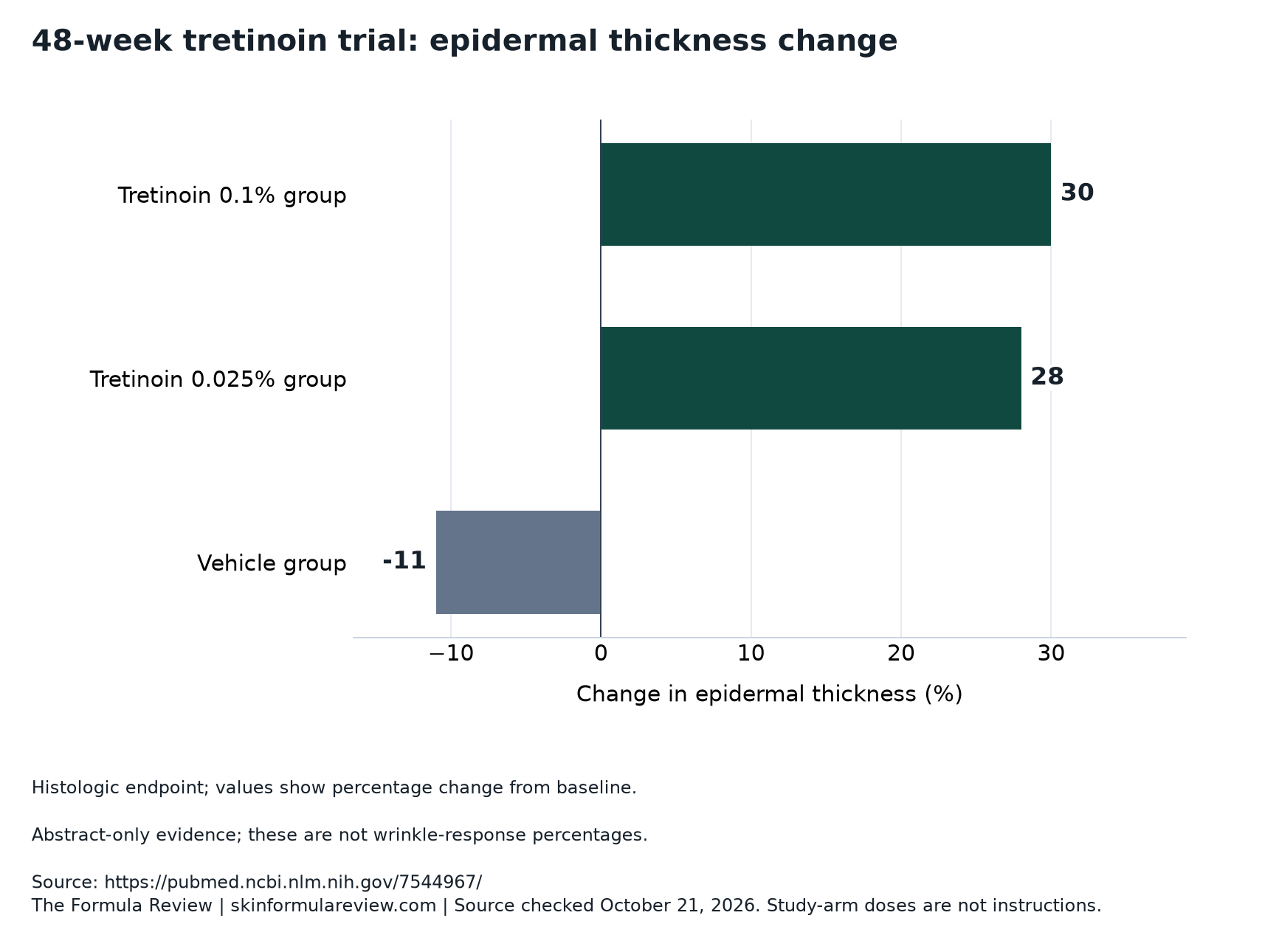
48-week tretinoin trial: epidermal thickness change
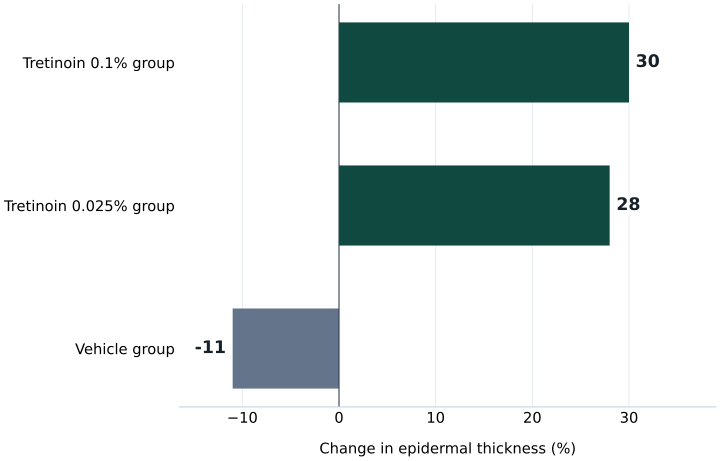
Histologic endpoint; values show percentage change from baseline.
Abstract-only evidence; these are not wrinkle-response percentages.
Download the source-labeled chart (PNG) · Download the data (CSV) · Download the chart (SVG)
| Study group | Reported value |
|---|---|
| Tretinoin 0.1% group | 30 |
| Tretinoin 0.025% group | 28 |
| Vehicle group | -11 |
Sections in this article
Identify the preparations before interpreting their comparison
In the indexed 1995 abstract, 99 people completed a double-blind facial-photoaging study lasting 48 weeks: 32 received 0.1% tretinoin cream, 35 received 0.025%, and 32 received vehicle. Active treatments improved clinical photoaging versus vehicle, with no clinically or statistically significant efficacy difference between concentrations. Higher concentration caused greater erythema and scaling. Histology measured epidermal thickness and vascularity. Starting enrollment, allocation procedure, attrition, clinical effect sizes, confidence intervals, detailed vehicle composition and funding are unreported in the abstract.
The first interpretive task is to define the contrast. A concentration comparison asks about specified preparations at different strengths. A vehicle comparison asks about an active preparation relative to its comparison base. A comparison between unrelated finished products may vary several features at once. These questions are connected, but their answers need not isolate the same causal contribution.
A rigorous description therefore separates the intervention's identity from the claim made about it. Ingredient information identifies what is present; an experiment estimates a defined result under its conditions. To move from one to the other, ask which features were held constant, which were intentionally changed and how the outcome was assessed. That sequence helps prevent a general ingredient association from replacing a specific product comparison.
Distinguish a concentration ratio from a response ratio
A concentration describes an amount relative to a defined quantity of preparation. It is not itself a measure of improvement. Even when two concentrations are expressed on the same basis, dividing one by the other supplies a compositional ratio. Predicting a clinical response requires observations connecting the preparation to the specified endpoint in a relevant population.
For a purely illustrative calculation, suppose an ingredient's proportion in one hypothetical preparation is three times that in another. The ratio is three. Nothing in that arithmetic establishes three times the visible benefit, three times the discomfort or one-third the time to improvement. Those would be additional empirical claims. A straight line relating concentration to response would be a model to test, not a consequence of the percentage printed on a label.
A response curve could take several shapes; distinguishing among them requires suitable concentrations, outcome measurements and uncertainty estimates. The fine-lines reference identifies the concern, while an investigation of concentration and response must define how that concern is scored. A larger ingredient proportion and a larger treatment effect should remain separate entries until evidence connects them. This is a measurement principle, not a recommendation to alter the amount or frequency of any preparation.
Ask which background conditions the vehicle controls
A vehicle serves as a comparison base within an experiment. Its role is defined by the study question and how it relates to the active preparation. Calling something a vehicle does not make it equivalent to an unrelated retail product. To evaluate a controlled contrast, the reader needs to understand which background properties are shared and which differences the contrast is intended to capture.
Imagine an experiment that changes both the ingredient concentration and the base at the same time. If the clinical outcomes differ, the comparison alone cannot assign the difference uniquely to either change. A design with additional matched comparisons could help separate their contributions. This hypothetical problem is called confounding of the changed features: more than one explanation travels with the intervention contrast.
Matching a base also does not remove every other design question. Application procedures, accompanying care, assessment conditions and follow-up can affect interpretation. These features should be specified rather than treated as automatically identical. The scientific value of a control lies in the alternative it represents. A carefully defined comparator helps narrow an explanation; the word control, by itself, does not establish that every possible difference has been eliminated.
Keep an ingredient change separate from a concentration change
The full publisher retinol paper reports a randomized paired-arm experiment in 36 adults averaging 87, using laboratory-prepared 0.4% retinol lotion and vehicle on sun-protected upper inner arms for 24 weeks. Twenty-three completed. Analysis included everyone, carrying last observations forward for incomplete follow-up. Mean primary fine-wrinkle changes on a 0–9 scale were −1.64 (95% CI −2.06 to −1.22) versus −0.08 (95% CI −0.17 to 0.01), P<.001. Three withdrew for cutaneous symptoms. Four investigators reported patent-inventor interests and potential royalties conditional on licensing and product sales; no separate funding statement was located.
An ingredient substitution introduces a different question from changing the proportion of the same ingredient. A numerical conversion between ingredient percentages would need an explicitly defined outcome and evidence supporting that relationship. Chemical relatedness alone does not supply a clinical conversion rule. The retinol research article examines its own evidence without assigning a corresponding tretinoin percentage.
Missing observations add another analytical issue. Consider an invented example in which a person's last recorded score is 4 and the final score is unknown. Reusing 4, assuming later improvement to 3 and assuming deterioration to 6 yield different endpoint contributions. The example does not represent a participant in the research. It demonstrates why a method for retaining people in an analysis must be distinguished from obtaining their final measurements and why sensitivity to plausible assumptions matters.
Use additional comparisons to examine an added ingredient
Suppose a proposed formula combines hypothetical ingredients A and B. Comparing the combination with a base could estimate the combined preparation's effect, but would not by itself isolate each ingredient's contribution. An experiment with base, A alone, B alone and A plus B creates additional contrasts. A design studying combinations of factors this way is often called factorial.
The invented table illustrates an additive comparison on a score-change scale. The separate improvements sum to three points, while the combined condition improves by four. The remaining one-point difference is a numerical departure from additivity in this example. It is not evidence that any real ingredients act synergistically: that judgment would also require an appropriate design, precision estimates and a specified definition of interaction.
Interaction depends on the scale used. A departure from additivity in score points is a different question from departure from a multiplicative relationship in another measure. The analysis should specify its model before attaching a biological explanation. The pigmentation reference organizes one clinical concern; a combination claim would still need an outcome, comparable preparations and contrasts capable of addressing the proposed contribution. No ingredient or regimen is being proposed by this teaching example.
| Illustrative condition | Mean score reduction at week 20 | Comparison made possible |
|---|---|---|
| Shared base | 0 points | A reference for the other conditions |
| Ingredient A in the base | 2 points | A relative to the base |
| Ingredient B in the base | 1 point | B relative to the base |
| A plus B in the base | 4 points | The combination relative to either single ingredient and the base |
Specify what equivalence would mean for a formula
Equivalent can refer to several propositions: matching composition, comparable measured exposure or sufficiently similar clinical outcomes. Evidence for one proposition is not automatically evidence for the others. A defensible comparison first names the quantity whose similarity matters. Otherwise the word can move between laboratory description and clinical implication without a clear test connecting them.
Clinical equivalence also requires a justified margin: the largest difference considered acceptably small for the chosen question. An uncertainty interval must be evaluated against that margin using an appropriate analysis. A conventional test that does not detect a difference answers another question. Its interpretation depends on precision, including whether the observations could distinguish a clinically important difference from a small one.
The endpoint's units remain essential. A microscopic area, a clinical severity category and a participant's reported discomfort cannot share a margin merely because all are expressed numerically. For an illustrative measurement distinction, increasing a tissue quantity from 30 to 33 units is a 10% relative change. It supplies no percentage of wrinkles removed and no equivalence margin for a clinical scale. Formula comparisons become interpretable when composition, endpoint and uncertainty remain connected to their respective definitions.
Consider how recognizable preparations affect assessment
Blinding is intended to limit the influence of knowing which preparation was used. In a hypothetical formulation comparison, differences in appearance or feel could reveal treatment identity. Visible reactions could also give clues. These possibilities do not establish that blinding failed in any particular study; they identify features investigators can assess when designing and interpreting a comparison.
The relevant question is who knows what. Someone applying a preparation, someone receiving it and someone scoring an outcome can occupy different roles. Concealing identity from an evaluator may address one source of influence while leaving another unresolved. Standardized instructions and assessment conditions serve additional purposes. A broad design label should therefore lead to more precise questions about procedures rather than substitute for them.
The mature-skin reference names a clinical context, but judging improvement requires a measurement process. Tolerability should be measured separately from efficacy, with defined symptoms, severity and observation periods. A visible reaction could affect comfort, adherence or an evaluator's expectations without proving a mechanism of benefit. Establishing a causal pathway would require information about timing and alternative explanations. That is a different investigation from describing how often a reaction was observed.
Separate clinical follow-up from formulation stability
A different randomized study, available here through its indexed abstract, involved 204 people with moderate to severe facial photodamage receiving 0.05% tretinoin emollient cream or vehicle for up to two years. Clinical outcomes favored tretinoin (P<.05); effect sizes and confidence intervals are absent. A procollagen marker increased at month 12, while specified atypia measures did not increase versus vehicle. The abstract does not identify funding.
A clinical follow-up period and a formulation-stability experiment answer different questions. The former observes defined outcomes during a study. The latter would measure properties of a preparation over time under specified conditions. One cannot be substituted for the other merely because both involve a calendar. Likewise, a laboratory stability result would not alone establish the size or durability of a clinical benefit.
Duration should also be attached to the question being asked. Improvement while treatment continues, persistence after treatment ends and the timing of adverse effects require different observations. A biological marker can contribute information about a process without measuring prevention of a clinical event. A useful comparison of formulations therefore identifies the relevant kind of evidence: composition over time, measured exposure or participant outcomes. These distinctions allow a longer investigation to add information without turning duration into a universal assurance.
Read the exact labeled preparation as its own record
Current RENOVA labeling, read in full, specifies 0.02% tretinoin by weight in an oil-in-water cream for mitigation of fine facial wrinkles alongside comprehensive skin care and sunlight avoidance. It does not claim wrinkle elimination or photodamage repair. Irritation, increased sunburn susceptibility and avoidance during pregnancy or attempted pregnancy are relevant warnings. Approximately 4% discontinued the drug because of adverse reactions. The label reports no head-to-head irritation or efficacy comparison with the older 0.05% formulation.
A named product's label identifies a particular preparation and the scope of its documentation. The RENOVA review offers a route to that record, while any proposed comparison still needs an explicit match between products and outcomes. A broad ingredient category does not identify every relevant formulation feature or give every product the same labeled indication.
To interpret a product claim, write down its subject and predicate: which preparation, for which measured outcome, under which conditions. Then identify the evidence that connects them. A research report and a label may serve different roles in that evaluation without contradicting each other. The goal is to preserve the scope of each document. Product-specific language should remain attached to the product it describes, and an experiment should be interpreted through the intervention and comparison it actually evaluated.
Match the changed feature to the necessary evidence
A comparison becomes more useful when it states exactly what changes between preparations. The table below turns that principle into several experimental questions. It is a framework for evaluating claims, not a finding that any named commercial products are equivalent or different. The appropriate evidence depends on whether the change concerns concentration, base, ingredient identity or an additional ingredient.
These distinctions are especially relevant when a description emphasizes a customized or combined preparation. Descriptive language can identify a feature worth investigating, but it does not supply a controlled comparison. If several features change together, a product-level comparison may still be informative while leaving individual contributions unresolved. The claim should say which question was answered, rather than assigning a combined result to a single chosen component.
My editorial interpretation is that service documentation should be examined separately. Readers can consult the Skin Medicinals review and Dermatica review for documentary terms without assigning either provider the results of an experimental preparation. These links make no availability or outcome claim. A transparent review identifies the proposed formulation comparison, the evidence needed to assess it and any additional practical questions that require their own records.
| Feature being changed | Question for a suitable comparison | Boundary of the inference |
|---|---|---|
| Concentration of the same active | What clinical contrast is estimated between the specified preparations? | The concentration ratio alone is not a response ratio. |
| Vehicle or base | How are the active and other study conditions held comparable? | Simultaneous changes can prevent attribution to the base alone. |
| Active ingredient identity | What evidence connects each ingredient to the same defined endpoint? | Related names do not establish a clinical conversion formula. |
| An additional active ingredient | What contrasts separate the combination from its components? | A combined result does not isolate each component's contribution. |
Questions about the evidence
Does vehicle mean that nothing relevant happened in the comparison group?
No. Vehicle describes the preparation's role as a comparison base. Interpreting an outcome still requires measurements from that group and knowledge of accompanying conditions. Assuming a comparator had no response would remove part of the evidence needed to evaluate the active preparation's relative effect.
Why is there no automatic clinical conversion between ingredient percentages?
A percentage identifies a proportion within a preparation. Converting it into a clinical prediction requires a defined outcome and evidence connecting the relevant ingredients and formulations to that outcome. Numerical similarity or chemical relatedness does not provide that relationship without an appropriate investigation.
What evidence would identify the contribution of an added ingredient?
Useful contrasts would separate the combination from the relevant individual components under comparable conditions. The analysis would also specify the endpoint and how interaction is defined. An improvement in a combined-treatment group alone cannot identify how much each ingredient contributed or whether their effects interacted.
Can a formulation comparison establish both effectiveness and comfort?
It can investigate both if each has a suitable outcome definition and collection procedure. Appearance ratings, participant-reported symptoms and treatment interruptions capture different aspects of experience. A favorable result on one should not silently replace the others; interpretation should preserve the benefit and tolerability measurements separately.
What should a reviewer do when a formulation detail is unavailable?
Identify the detail as unresolved and narrow the comparison accordingly. An absent description is not evidence that preparations match, and it is not proof that they differ. The next step in evaluating the claim is to identify the documentation or experiment that would resolve that specific uncertainty.
Editorial assessment
Formulation evidence is strongest when the comparison makes clear what changed and what was measured. Concentration, vehicle, ingredient identity and added components each create different experimental questions. A useful review keeps those questions separate while examining the relevant clinical contrast, uncertainty and tolerability. It also distinguishes a product's documentation from a result obtained under research conditions. This approach supports precise comparisons without inventing conversion rules, assigning a combined effect to one ingredient or treating a shared active name as proof of equivalence.
Research access and limitations
Source access is identified in the study and labeling summaries. No participant-level records, protocols or supplements were reviewed. The numerical examples and unnamed ingredients are illustrative only. The article does not establish bioequivalence, propose compounded formulas or provide personal dosing instructions. Broader comparisons require evidence appropriate to the preparations, populations and endpoints involved.
Sources and access notes
Sources checked October 21, 2026. The access notes below identify the material examined for this article.
- Two concentrations of topical tretinoin (retinoic acid) cause similar improvement of photoaging but different degrees of irritation. A double-blind, vehicle-controlled comparison of 0.1% and 0.025% tretinoin creams.
Indexed original research abstract · Checked October 21, 2026
- DailyMed - RENOVA- tretinoin cream
Official current labeling retrieved in full · Checked October 21, 2026
- Improvement of naturally aged skin with vitamin A (retinol).
Full publisher research article, including original clinical table-image footnote, figure captions, Comment and Financial Disclosure; no supplements or individual data reviewed. · Checked October 21, 2026
- Long-term efficacy and safety of tretinoin emollient cream 0.05% in the treatment of photodamaged facial skin: a two-year, randomized, placebo-controlled trial.
Indexed original research abstract · Checked October 21, 2026