A formula deserves a more precise description than the name of its best-known ingredient. When reading a clinical paper, the useful question is what preparation was compared with what alternative, under which conditions. When evaluating a different product, a second question follows: which parts of that experimental description still match? The answer determines whether a citation provides direct evidence, background context or a reason to conduct another study.
The Formula Review approaches this problem as a chain of comparisons. An active ingredient, its concentration, the surrounding preparation and the way an outcome is measured belong to the same chain. Changing one link creates a question that deserves explicit attention. The following analysis develops that approach through study design, numerical reasoning and clearly hypothetical examples. It does not reconstruct a treatment recipe or turn a historical research schedule into personal instructions.
24-week retinol study: fine-wrinkle change
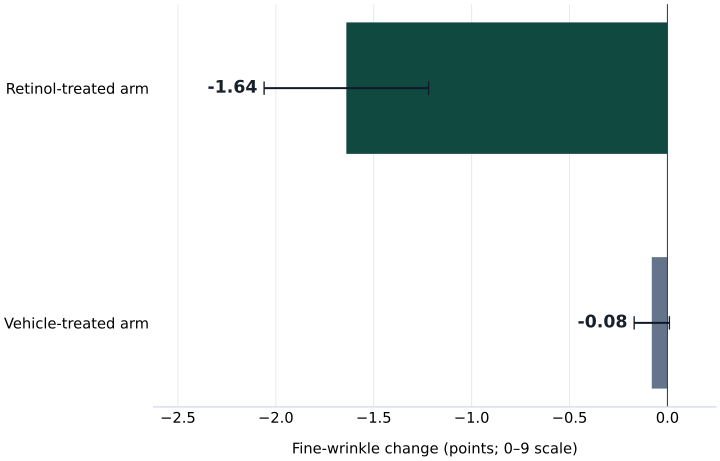
Paired arm comparison; whiskers show 95% confidence intervals.
Score changes are not percentages; intervals describe arm means.
Download the source-labeled chart (PNG) · Download the data (CSV) · Download the chart (SVG)
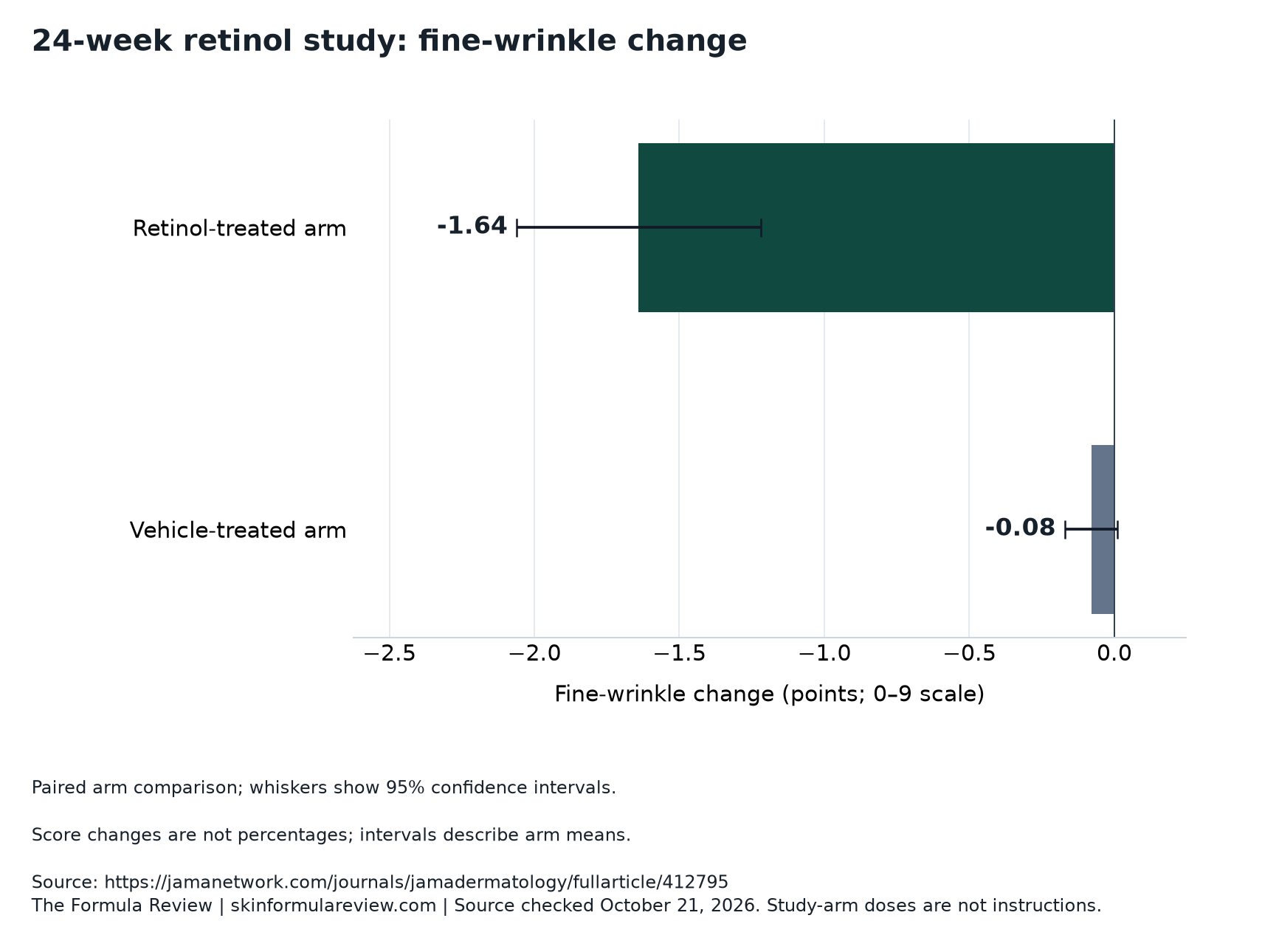
| Study group | Reported value | 95% confidence interval |
|---|---|---|
| Retinol-treated arm | -1.64 | -2.06 to -1.22 |
| Vehicle-treated arm | -0.08 | -0.17 to 0.01 |
Sections in this article
Describe the entire experimental contrast
Begin a formula assessment with two descriptions, not one. Write down the tested preparation and the comparison preparation beside it. The word vehicle identifies the base used for comparison; it should not be casually translated into no skincare. This distinction helps define the effect being estimated. A comparison with a base asks a narrower question than comparing a complete routine with receiving nothing.
An original hypothetical example makes the boundary clearer. Imagine that preparation A contains a named ingredient in base X, while its comparator contains base X without that ingredient. The experiment is organized around that specific difference. Now imagine preparation B uses the same ingredient in base Y. The original comparison does not establish that A and B produce equivalent results. A separate investigation must address the changed preparation rather than treating the ingredient name as a complete product identity.
Our assessment methodology provides context for keeping documentary questions separate from clinical findings. For scientific interpretation, a useful record includes identity, concentration, comparator, population and outcome. A missing entry does not prove that a product is ineffective. It means the proposed connection between two preparations has not yet been fully described, which is a much more precise uncertainty to investigate.
| What appears to match | Information to verify | Question still requiring evidence |
|---|---|---|
| Ingredient name | Exact identity of the ingredient being discussed | Is the clinical claim about this same substance? |
| Printed concentration | What quantity the percentage describes | Does a matching percentage establish a matching outcome? |
| Preparation type | The base and the complete formulation | Has the proposed alternative been compared directly? |
| Combination claim | Every component and the intended comparison | What evidence separates individual and combined effects? |
The participant, the treated site and the intended reader
A paired-site comparison uses a person as the setting for both conditions. The observations are linked because they come from the same individual. An analysis should respect that connection: two measurements from one person do not become two independently recruited participants. This is a design feature that affects both the estimate and the amount of information available to estimate uncertainty.
Random assignment addresses the allocation of treatment. It does not automatically make the recruited population representative of every possible reader. Internal validity asks whether a comparison is credible within the study; external relevance asks whether that comparison answers a question in another setting. These are related but distinct judgments. Strength in one does not remove the need to investigate the other.
When using the mature-skin directory, readers can apply this distinction without guessing their own response. List the target population and target skin area for the claim being evaluated. Then compare them with the experimental description. An apparent mismatch is not a calculation of how much the effect changes. It identifies a question for further research. A convincing extension would explain why the changed setting should matter little, or test the relevant outcome there directly.
A concentration is a description, not an exchange rate
A percentage becomes interpretable only after identifying what is being counted and the basis of the measurement. It does not, by itself, rank finished preparations. Even where two products display the same number, the clinical question remains whether their relevant effects have been compared under conditions that support such a conclusion. A similarity in notation is not the outcome of an experiment.
Consider an invented comparison between ingredient A at one concentration and ingredient B at a different concentration. Dividing the printed numbers yields an arithmetic ratio. It does not establish a conversion between substances, an equivalent application amount or an equivalent clinical response. Those would be biological conclusions, and they require evidence beyond the arithmetic. The same problem arises when a formula is described as stronger without specifying the outcome by which strength is judged.
The companion study of tretinoin concentration and irritation examines a related question: how to interpret a reported similarity without treating it as a formal demonstration of equivalence. For a future formula comparison, investigators would need to define what difference would count as important before using a result to support interchangeability. This keeps the reasoning tied to a stated clinical objective rather than a ladder constructed from percentages alone.
The vehicle comparison and the meaning of change
Before interpreting an improvement, distinguish change within a condition from the difference between conditions. A before-and-after observation describes movement over time. A controlled comparison asks how that movement differs when the alternative condition is included. The two quantities answer different questions, even when they appear in adjacent columns of the same table.
Here is a deliberately invented numerical example. Suppose a lower-is-better score falls by 1.2 points under one condition and by 0.3 under its comparator. The difference in change is 0.9 points in favor of the first condition. That calculation does not tell us why the comparator changed, and it should not be reported as a percentage of people benefiting. It preserves a narrower meaning: a contrast between two average changes on a specified scale.
For measurements paired within individuals, the uncertainty of this contrast also depends on the relationship between the two measurements. Separate uncertainty intervals for each condition are not enough to construct a valid interval for the paired contrast by subtracting their ends. A formula review should therefore keep the reported analysis intact, identify any new calculation as arithmetic, and avoid supplying an interval or personal prediction that the evidence does not support.
Read the scale before assigning cosmetic meaning
A rating score is a way of organizing an assessment. Its units should remain attached to its changes. A one-point movement on a severity scale is not automatically one fewer wrinkle, a fixed area of smoother skin or a particular number of years of visible aging. Those interpretations would require a demonstrated relationship between the rating and the physical or personal outcome of interest.
For another hypothetical example, a score could move from eight to seven while a different score moves from two to one. Both changes equal one point. Their relative changes differ, but neither arithmetic expression establishes how important the change feels to a participant. To evaluate practical meaning, a researcher could specify an interpretable threshold in advance and collect an outcome suited to that question. A review should identify that missing interpretive step rather than silently inventing a threshold.
Uncertainty deserves the same discipline. A confidence interval concerns an estimated quantity under an analysis model; it is not a catalog of individual responses. A standard error describes estimated variability of an estimator and is not interchangeable with a confidence interval. When reading fine-line comparisons, inspect the units and the type of interval before comparing the apparent size of two plotted effects. A chart becomes more informative when its labels constrain the interpretation.
Exposure and missing follow-up belong in the formula record
Staff planned up to three applications weekly; actual mean exposure was 1.6 with irritation-related withholding.
Exposure describes what happened during an investigation, not simply what its schedule permitted. This distinction connects tolerability to interpretation. If participants receive different amounts of an intervention, comparing those groups afterward may mix exposure with the reasons exposure differed. It would be inappropriate to treat that observational comparison as a clean test of which schedule works best.
Intent-to-treat and last observation carried forward address another part of the record. The former aims to retain assigned participants in the comparison; the latter inserts an earlier available measurement where a later value is missing. Consider an imaginary participant whose final visit is unavailable. Reusing a previous score makes the calculation possible, but it cannot show whether the unobserved final score would have been better or worse. Excluding that person instead changes the analyzed population. Neither choice should disappear behind a single result label. The scientific question is how sensitive the conclusion would be to plausible missing outcomes, which can be explored with explicitly stated alternative assumptions.
Biological measurements and combination claims need their own tests
Only significant biopsy findings were reported: glycosaminoglycans n=6 and procollagen I n=4. Injury/ulcer prevention was hypothetical.
A biological measurement can help develop an explanation without proving it. If a tissue signal and a clinical score both change, the causal connection between them remains a separate question. They might be connected, or they might reflect different consequences of treatment. Demonstrating that one pathway accounts for an outcome requires more than finding both observations in the same report.
Reporting only findings that cross a significance threshold also limits the view of the experimental program. An analyst needs to know which tests were considered and how their selection affects interpretation. This matters when evaluating a proposed combination: two individually plausible components do not automatically produce an established combined benefit. A hypothetical factorial study could compare neither component, each component separately, and both together. That arrangement would allow investigators to ask about individual contributions and possible interaction using a prespecified analysis. It would still need appropriate participants, outcomes and safety observation. Adding a component to a label is therefore a new research question, not a completed causal argument.
Different reports should retain separate identities
The 1995 abstract reports 99 completers over 48 weeks with 0.1% or 0.025% tretinoin cream versus vehicle; higher concentration produced more erythema and scaling. The 2005 randomized report studied 204 participants and 0.05% tretinoin emollient cream versus vehicle for up to two years. It describes improvement in facial photodamage without numerical effect estimates or confidence intervals in the abstract.
Reading such reports together can reveal useful questions about design and interpretation. It does not create a randomized comparison between their preparations. Differences in participants, measurements, follow-up and treatment management would have to be addressed before a cross-study ranking could be credible. A larger concentration or a longer observation period does not repair the absence of a direct comparison.
This is especially important when a formula contains several named ingredients. The appropriate evidence depends on the claim being made: effectiveness of the complete preparation, the additional contribution of one component, or similarity to an established alternative are different objectives. A literature review should state which objective each report addresses. Readers can then distinguish a supporting background rationale from the kind of comparative evidence needed to assess a finished-formula claim.
| Record | Available evidence | Interpretive task |
|---|---|---|
| 1995 tretinoin concentration study | Indexed primary abstract | Separate observed similarity from an equivalence design. |
| 2005 longer-duration tretinoin study | Indexed primary abstract | Keep duration distinct from effect size and precision. |
| RENOVA 0.02% cream | Current official product label | Retain the exact formulation and its stated limits. |
Product labeling and financial interests require precise attribution
Four investigators disclosed conditional patent royalties, not confirmed study sponsorship or payments. A disclosed interest should prompt transparent scrutiny of the research, while avoiding a different unsupported claim about who financed it. An author affiliation, ingredient supplier’s name or proposed commercial use does not substitute for an explicit funding record.
RENOVA 0.02% is labeled for adjunctive mitigation of fine facial wrinkles alongside comprehensive skincare and sunlight avoidance. Its label does not claim wrinkle elimination or repair of sun-damaged skin. Safety and effectiveness beyond 52 weeks or above age 71 are not established. The label says not to use it during pregnancy or when attempting pregnancy. Those are product-specific statements, not labeling for a retail retinol preparation.
The editorial implication is to keep three identities visible: the experimental preparation, the product whose label is being read and the offer being reviewed. A result may inform a discussion without changing the scope of another product’s label. Likewise, a disclosed financial interest neither validates nor automatically invalidates an estimate. Scientific appraisal still requires examining allocation, measurement, follow-up and analysis, while keeping documented commercial relationships available for the reader to assess.
Ask what evidence would connect the alternative formula
A useful final appraisal names the comparison that remains to be made. If the claim concerns an added ingredient, ask how its additional contribution would be isolated. If the claim concerns interchangeability, ask which outcome and acceptable difference would define it. If the claim concerns a different population or skin area, ask what observations would establish relevance there. These questions turn a general uncertainty into a specific research objective.
The source register supports that documentary trail. For commercial terms, the Musely Anti-Aging Cream review and Agency Night Renew Rx review provide places to inspect the relevant records. These are links for checking documentation, not evidence that either offer reproduces the experimental preparation or its outcomes. Our editorial interpretation is that a review becomes clearer when each clinical, formulation and purchasing claim carries its own evidentiary task.
Before accepting a broad claim, try writing the experiment that would answer it. Specify the alternative, the people enrolled, the measurement, the observation period and the handling of discomfort or missing visits. If those choices cannot be made clearly, the claim may still be too vague to evaluate. A well-defined question helps readers recognize useful research while identifying exactly what an ingredient list, a photograph or a numerical concentration leaves unresolved.
Questions about the evidence
What should be recorded besides the active ingredient’s name?
Record the concentration, complete preparation, comparator, population and outcome relevant to the claim. Then identify which of those details match the proposed alternative. This is an editorial framework for locating uncertainty. It does not presume that any particular mismatch necessarily changes the outcome; that possibility needs evidence suited to the question.
Is a vehicle-controlled result the same as the effect of an entire routine?
The two comparisons need not ask the same question. A vehicle-controlled design organizes a contrast against a specified base. A whole-routine claim would need to identify the complete alternative routine and the outcome being compared. The relevant effect is defined by both sides of the comparison, rather than by the active preparation alone.
Why does a familiar ingredient not establish a combination’s performance?
A claim about a combination concerns the preparation as used, including whether the components add to or modify each other’s effects. A rationale for an ingredient can motivate testing, but it does not settle that comparison. A suitably designed experiment would need to distinguish the contribution being claimed and measure the outcome directly.
Can the shape of error bars show which formula is better?
Only after identifying what the bars mean and what comparison the study supports. Confidence intervals, standard errors and variation among individual participants describe different quantities. Visual overlap alone is not a substitute for the planned analysis, particularly with paired measurements. A credible ranking requires an appropriate contrast and a clear definition of the outcome.
Does longer follow-up automatically resolve every uncertainty?
Longer observation can answer questions about time, but its value also depends on who remains observed, what is measured and how missing data are handled. It does not automatically establish equivalence with another preparation or address a different population. The follow-up period should be read as one design feature among several, rather than a universal quality score.
Editorial assessment
The strongest formulation appraisal preserves the exact question behind an estimate. It identifies the preparation and comparator, respects the measurement scale, and considers how exposure and unavailable observations affect interpretation. It then asks what evidence would support a connection to the alternative being discussed. This approach gives clinical research a clear role without asking an ingredient name to carry more meaning than it can. The next useful step is a specified comparison or an identified document, not a claim of equivalence assembled from familiar names and printed percentages.
Research access and limitations
The retinol analysis uses the full publisher article, including the original clinical table footnote and financial disclosure. The 1995 and 2005 tretinoin discussions use indexed primary abstracts; regulatory context uses the current official RENOVA label. Supplements, individual data and trial-registry records were not independently examined. Worked examples and proposed future designs are original illustrations, not reported study results. This article provides scientific education rather than a personal regimen.
Sources and access notes
Sources checked October 21, 2026. The access notes below identify the material examined for this article.
- Improvement of naturally aged skin with vitamin A (retinol).
Full publisher research article, including original clinical table-image footnote, figure captions, Comment and Financial Disclosure; no supplements or individual data reviewed. · Checked October 21, 2026
- DailyMed - RENOVA- tretinoin cream
Official current labeling retrieved in full · Checked October 21, 2026
- Two concentrations of topical tretinoin (retinoic acid) cause similar improvement of photoaging but different degrees of irritation. A double-blind, vehicle-controlled comparison of 0.1% and 0.025% tretinoin creams.
Indexed original research abstract · Checked October 21, 2026
- Long-term efficacy and safety of tretinoin emollient cream 0.05% in the treatment of photodamaged facial skin: a two-year, randomized, placebo-controlled trial.
Indexed original research abstract · Checked October 21, 2026